Gringo City: Popoyo and the Cost of Surfing Eden
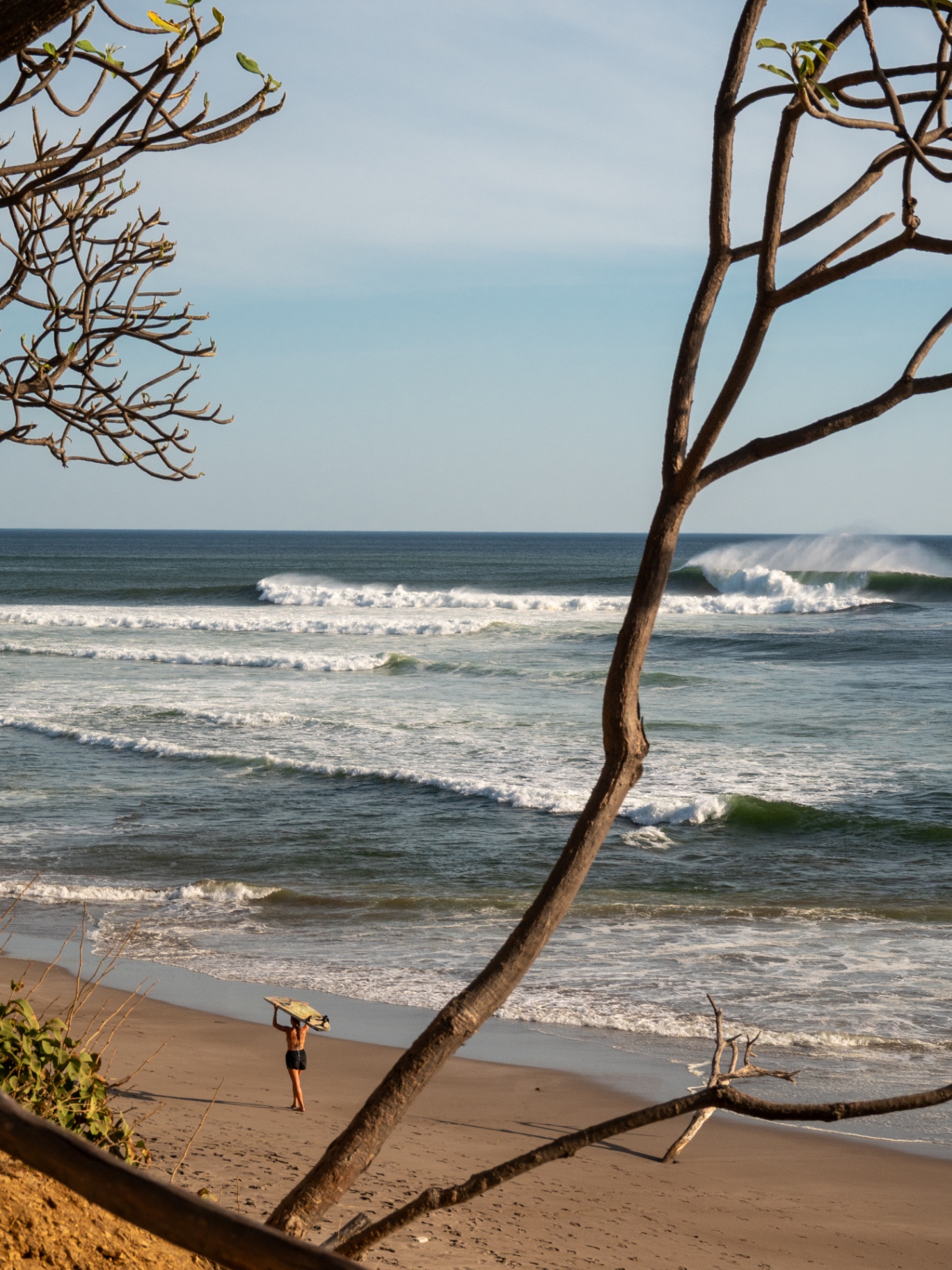
From within Nicaragua's surfing Eden, a reflection on what happens when a town's name, beaches and economy are quietly bought, renamed and rerouted away from the people who shaped them.
By Alex Day
Popoyo is unarguably exotic, as though the topography belongs as much to imagination as it does to the physical world. Presenting itself as the surfing Eden of Nicaragua's Pacific coastline, it is a carrot of gold for the surfer's mind.
Three hundred and sixty days of offshore winds — a candy shop for the children of the ocean's classroom. It sounds dreamy, utopian, everything a servant to swell lines could want.
It is funny, though, how our wants can sometimes ruin the experience of meeting them.
Living adjacent to these unearthly breaks, that truth is written across the landscape. The level of beauty, of rides, of uniqueness these god-gifted breaks offer — ranging from beginner to advanced, reef to beach, hollow to playful, A-frame, left to right, point break to shorie — plays with the human mind.
I mean all surfing does; surfers know that. But the commitment — almost lust — is for the freedom of mind, not being controlled by it.
The potential of waves can sometimes stir something deeply human, engaging the part of us that believes satisfaction lies just beyond reach, in the daydream of the next ride, the next moment of oceanic connection. In that pull, we may find ourselves persuaded to set aside our better judgment and subtly override our ties to the integrity of surfing. When left unchecked, the path to attainment can narrow the broader vision of what matters, neglecting the consequences of our gain in favour of the urgency of our desires.
There is an irony in this, because often, what we long for holds its beauty precisely because it remains untouched; grandness exists more perfectly in possibility than in possession.
There will always remain a kind of heaven in what we have yet to reach, and simultaneously, a quiet but pervasive absence in what we already have.
This truth revealed itself after spending time among those devoted to the ocean in Popoyo. After spending time integrating myself into the community, I became aware of how the waves had left people under the latter option of how our mind can respond to the magnet of surfing.
In this, I specifically speak about the town and the mindset it has attracted, which has been built to serve as a bridge for surfers to access the waves at Popoyo.
Popoyo is, in the words of my local taxi driver — who helped me make my way to Costa Rica and process the disappointment of where this progression is leading us — "Gringo City." I was not ashamed to fall under this title, but I was ashamed to be riding this community's waves and not having the opportunity to support it. Every search tab on my computer showcased western, foreign-owned accommodation, surf resorts, schools, and hostels. Walking down the small, simple streets, I noticed every day the four or five local restaurants sitting almost empty, while the developed cafés, restaurants, and bars were filled with customers. I was ashamed of how little opportunity there was to resist this saturation of monopolisation. The local community seemed almost absent in its own homeland, while the surfing community had taken over in the mere pursuit of waves.
Walking down to the main Popoyo break one late morning, I passed a local man who lived there with his family. Standing at my own chosen spot, I almost did not hear him. "Nice fin setup," he said, admiring the single fin and side-bite stability my surfing style favours. As we fell into conversation, he told me he was thinking about packing up, moving on, selling his land. "I have not really surfed in about 20 years." The reason for his time away from the ocean was the impact of the industry.
"The names of these beaches are not real. That right-hander over there," he said, pointing to the mechanical, glassy wave peeling one hundred metres to our left, "that was once named after me." Beginners' Bay. Popoyo Main. Foreigners who have come and bought the entire coastline of Popoyo have renamed the beaches to appeal to surfing tourists. They have so much money, and they have come here and just want more. They have ruined it for everyone. Australians, French, and Americans own the majority of this town.
Later that evening, I drifted down to a bar overlooking the ocean and got talking to a local around my age. Friendly and open, he told me he had grown up in Popoyo.
"Where is your favourite break?" I asked, curious to hear a local perspective.
"Somewhere out of Popoyo," he replied quickly. "I do not surf these waves here; they are too busy."
Disappointed by the reality of it all, I asked, "Because of the surfing tourists?"
"Yes," he said. "It is not enjoyable to surf here anymore."
The next day, I met two friends for a sunset beer, both of whom I had met in a northern surf town in Nicaragua. As the sun dipped over the horizon and cast an orange glow over the perfectly peeling A-frame break in front of us, they told me about their time here. Living and working in Popoyo for the past three months, they said it is an ecosystem of hierarchy, based on how long you have lived there, what you have, or what you intend to possess. A WhatsApp group exists in the northern side of Popoyo where they live, yet they said you are only added if you own land or intend to buy it. People will only try to integrate you or engage with you if you show interest in buying land. If not, you do not seem to factor into the equation. This group was not founded by locals or fuelled by them, but by foreigners who had moved into the town of Popoyo.
Walking back to my accommodation under the moon's glow, I bumped into a friend I had met in El Salvador.
"Did you go to Popoyo Secrets last night?" he asked, his voice still heavy with recovery.
"No, I gave it a miss for a fresh sunrise wave this morning," I replied.
It was not that I was not interested in a mingling boogie and cerveza with the population of Popoyo, but more a principle I could not shake. One of the more expensive, popular, and westernised hostels runs the party every Saturday night of the year. It costs $38 USD to enter, without drinks included. Hundreds of people go every week. At 200 people paying this entry fee, the hostel would be making around $7,500 USD — not including drinks — every week.
The business side of it is not the problem, but my question lies in how much of this goes back into the local community, and how much is simply funnelled into a foreign-owned hostel. From what I could gather in my time in Popoyo, from conversation and interactions, I did not hear any indication that the money was going anywhere else but back into the hostel.
Adding to this, the hostel, as well as many others, sources a lot of its labour through Workaway-style roles, where travellers work in exchange for accommodation and sometimes food. However, the negative impact this can have is often overlooked. As one local said to me, "This is a very big problem in Central America."
Foreigners not only buy and build but then bring in other foreign travellers to work for them for free, taking away local jobs and creating, to a certain extent, free labour.
For the surfing community, it is hidden beneath a surface of normalisation or lack of awareness of the impact our desire to surf exotic waves has on local communities. If we remain authentic in our commitment — almost a lust — for the freedom of mind offered through devotion to waves, should this not also mean our actions give rather than take from everything they touch?