The Chasm of Every Story
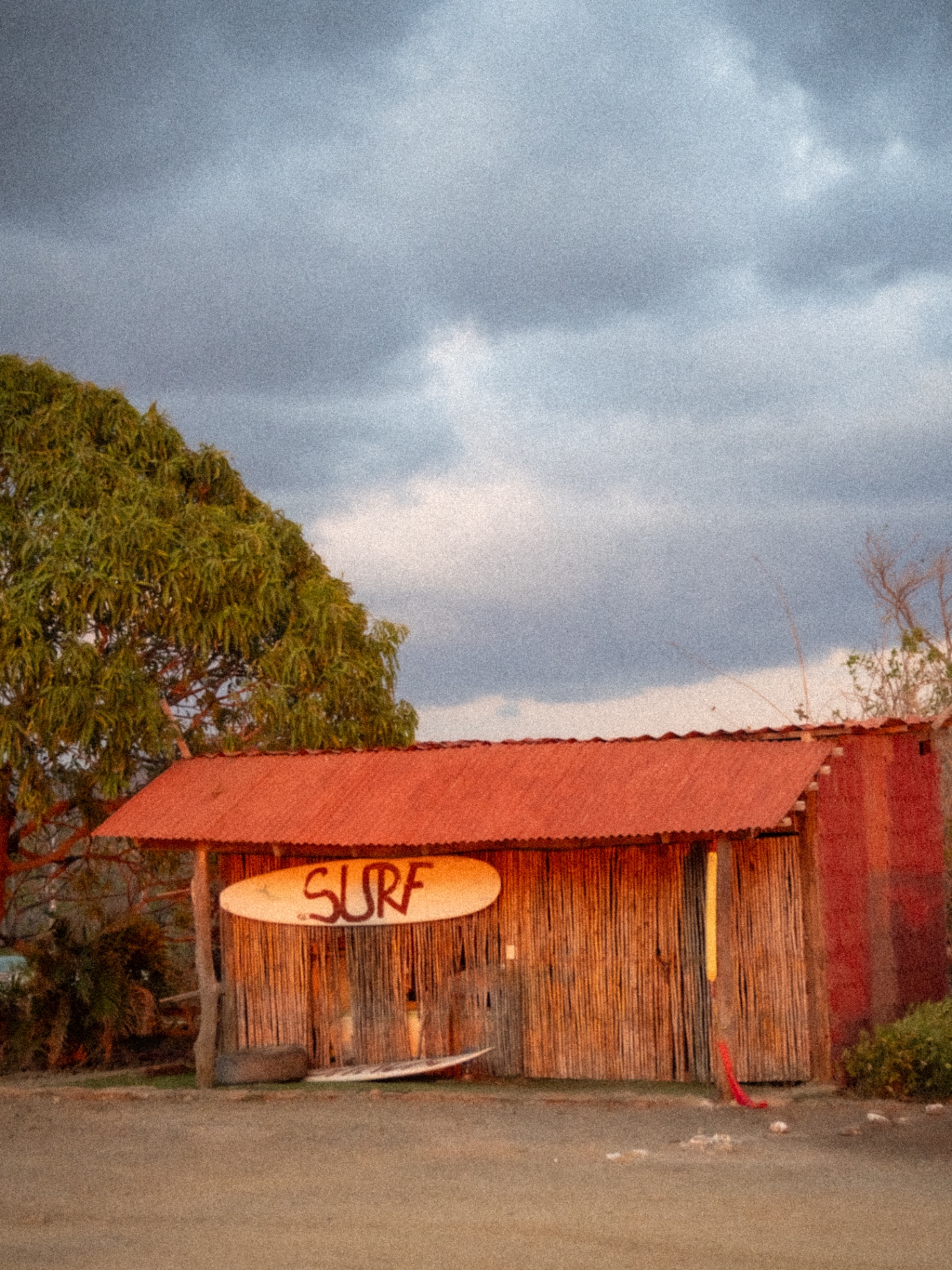
As surfers, we must ask whether there is a divide between the story the foreign surfer constructs and the reality the local community lives.
The names of locals who shared these experiences, perspectives, and thoughts have been withheld at their request, due to the current political and social environment of Nicaragua.
Heading north to the Nicaraguan coastline means driving through a whisper: “This is what Central America used to be like.” At least, that’s the echoing sentiment that transient swell-seekers tend to confess.
Before what, we might ask?
Before the fall; before “untouched” was rebranded as ownership. Before the fantasy calcified into memory: unknown, vacant, mystical waves. As surfers, isn’t there an ever-present utopia living in our minds — in what we wish to find? Aren’t we always pursuing the “before,” yet paradoxically encouraging the “more” that leaves it behind?
A kind of personal Eden within the imagination: untracked coastlines, the infancy of a break before fame, a simpler intimacy with the ocean. Is there a mutual longing for a world that is lost, touchable only in those recurring moments where it feels unlost again?
The call of “This is what Central America used to be like” could mark any surfer’s map of longing. Yet as surfers, we must ask whether there is a divide between the story the foreign surfer constructs and the reality the local community lives.
This town holds a deep chasm. Not visible from open water, it sits two hours south of the border — but as one local told me: “It’s all behind the closed gates.”
The number of surf retreats, schools, and housing compounds built for transient, non-local surfers can be counted on two hands. Walk down the town’s main street and it seems to embody a quiet understanding of “enoughness” — a pace untouched by excess, where contentment still appears possible. Perhaps it is this very quality that convinces the visiting surfer they have found their personal Eden.
Yet another reality exists alongside it.
“These places have big gates, and everyone who visits sits behind them,” a local told me as we rested between sets.
As the sets rolled in and out, as we picked our lines and paddled back to the peak, he shared the past and present truth of this town. Woven into his stories were the fears and hopes for its future.
“Before surf tourism hit this town, people here had a very pessimistic attitude — often saying that ‘everything is a bag of dicks.’ The history of Nicaragua has been immoral, turbulent, and gut-wrenching. These people had everything taken from them, and with it, any faith or belief in anything. Twenty years ago this town had very little. One family had only one spoon and one bowl for four children.”
A set wave found him and he rode it to the shore. When he returned to the line-up, he returned to his memories.
“Surf tourism later grew much more popular in this area, and the money from it flowed into the local community. It provided income, jobs, and the opportunity to move out of poverty. The real turning point wasn’t material — it was mindset. People began to see value in things, in their lives, in the future. That early stage of surf tourism in northern Nicaragua brought many positive impacts.”
There was a lull in his narrative, mirroring the lull in the water. Holding the horizon in his gaze, he continued:
“Then, after a while, it started to take more than it was giving us. Everything that once flowed outward began to be kept inward, held behind the gates of the resorts and schools they built. Now these resorts employ ten to fifteen foreigners and three or four locals. The locals are paid less than a quarter of what the foreigners earn. The owners roam around in five or more new cars while locals have a used motorbike. They don’t go to local restaurants or integrate into the community — they stay behind those gates. There are even one or two locals taking advantage of external surfers willing to pay. One man paid off the government to buy beach access and no longer allows other Nicaraguans to surf there — only foreigners. Foreign money is a magnet, and he has lost his integrity within it. The future of this town could go either way, and we are praying it will stay with us.”
The web confirms it all — and fuels it. All-inclusive retreat packages — coaching, photography, meals, social events — range from $1,500 to $3,300 USD per week. For perspective, according to the Global Living Wage Coalition, the average monthly gross wage in Nicaragua is $450 USD: $112 per week, or $16 per day.
As surfers choosing all-inclusive packages for ease, convenience, and comfort, we must ask where this investment is channelled. Does all-inclusive keep the gates closed? Does it exclude giving back to the very community within which these retreats sit? Does interaction — simple conversations, financial exchange, integration, mere connection — become negated from the experience of being a visitor? Do we deepen the chasm between the story the foreign surfer constructs and the reality the local community lives?
Because there is always a chasm — a life of the in-between: between what is visible and what is unseen, between what we know and what lives beyond our knowledge.
The chasm this dusty, remote, and humble town inhabits asks us to extend ourselves beyond the reach of our mental gates, beyond the reach of the surf industry, and to reclaim the world of the unlost.