The Things We Shape, Shape Us
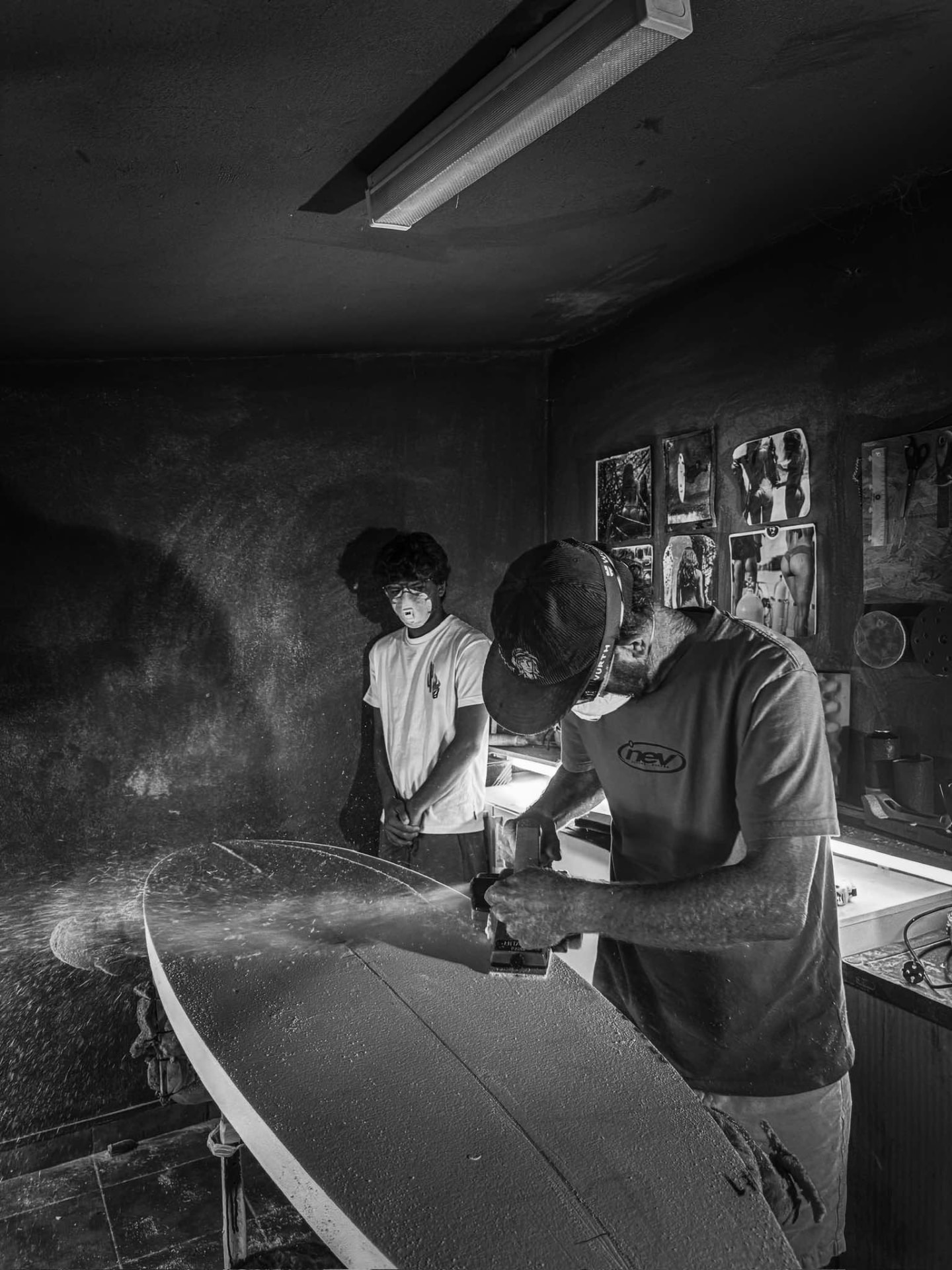
“To shape something is to understand that it can always be altered.”
We have a tendency to mistake familiarity for truth.
What we know is what “should” exist, and what we don’t know is quite easily discarded as “wrong”. The arc of surfing culture has not escaped this conditioning. And Nev, the founder of eras of surfboards — Nev Surfboards, Odyssey, Firewire — has been scrutinised for resisting conformity to familiarity.
Nev has not only seen both ends of surf culture’s lifespan, but he has helped shape it. He has adapted. Moved with the agreement life, surfing and surfers have with change: use it, and don’t deny its existence. Because ultimately, Nev’s competitors — other shapers, big brand labels, the voices outside of him and the opinions of how he “should” shape — told him the method of shaping ultimately overrides our relationship with a board. Specifically, that “there is no soul in a machine-shaped surfboard.”
Nev knows that, “It could be argued I encouraged the alteration in making surfboards.” He touched both methods.
He started shaping in Perth in 1970 under the name Nev’s Surfboards before transitioning into Odyssey, and then co-creating Firewire with Bert Burger, becoming the founder of some of the biggest names to label our surfboards.
He has not only shaped surfing culture through his surfboards, but one could say he has been an author of it. He honoured the method, the ocean and our desire to be with it perpetually through hand-shaping boards for decades. Then, Nev met a crossroads where what he loved so dearly asked him to adapt. To let go of the story of “should”.
“The way my competitors ‘back in the day’ would deal with demand is that they would have surfboard shapers all over the world doing Rusty, Al Merrick… They would have five to ten shapers working for them and I just couldn’t deal with that. It didn’t make sense to me.
“I had to be the guy designing the board.”
Integrity overrode growth.
The demand for his boards had outgrown his capacity to make them. To design them. Nev did not want to surrender his craft to other shapers purely because the dream of exposure and demand had arrived.
So he asked a different question: Are we willing to meet something unfamiliar without deciding what it is before we experience it?
His answer brought him to pioneer CNC computer shaping in the early 1990s: ultimately using a machine to carve the shape of a board with the dimensions the shaper asks it to.
The craft was still his. The design. The dimensions. The creation.
He had simply sourced a set of a thousand hands — the kind of hands an artist wishes they could work with. Much of the industry denied his imagination. Scrutinised it.
“I was criticised for changing the culture of making surfboards. Yet, I was able to have my boards authentically made globally without touching them,” Nev detailed. “My argument was, ‘Hey guys, we have to embrace technology. It is the relationship with what you have done.’”
And perhaps this is where the argument becomes bigger than surfboard shaping. The soul of a surfboard is psychological, not performance-based.
Nev’s competitors had attached the experience of the board to the reality it dwelled within: the wave, the board, and, at its roots, the method through which it was shaped. But Nev understood something different.
It is never simply what lies outside of us that determines how we experience something. It is our relationship to it. Nev tells us a story that confirms it all.
In his surfboard shop in Mermaid Beach in 2004, he had a range of brands — JS, DHD and his own boards. A guy walks in and says, “All the DHDs, they’re all handmade.”
Nev said, “Well, no they aren’t, but if you believe they are, that’s okay.”
There were two boards. One of Nev’s and one of Darren’s. Same width, same dimensions, pretty close. The man asked, “Which one do you think would go better?”
Nev replied, “whichever dimensions are closest to what suit you.”
The man replied, “No, but one’s machine-shaped and one’s hand-shaped. Where is the soul? I know the hand-shaped would go better.”
Nev’s response was simple.
“Only because you believe it. It is a psychological thing. It’s a trigger.”
Nev knew that if the man jumped on the two boards, he would guarantee he would ride the DHD better. He had already made the decision in his physiology. It had nothing to do with whether it was hand-shaped or not. It had everything to do with the relationship between him and the board. Between him and the shaper. Whether he actually spoke to the shaper or not didn’t matter.
“If someone buys a board off the rack, they haven’t spoken to Darren or me.”
Perhaps there is a flexibility in being a shaper that Nev understands better than most. To shape something is to understand that it can always be altered.
The outline can change.
The materials can change.
Technology can change.
What remains is the relationship between the surfer and what is beneath their feet.
“Every single surfboard manufacturer on the planet, with some exceptions, use the system that I helped to introduce. Every name brand — they are either using a CNC shaping machine or they are using someone else’s, because it works,” says Nev.
There is a preference to hold onto preconceptions. People initially judged Nev’s method of shaping rather than the experience of riding.
Oh, how often we attach assumptions to the things that are unfamiliar.
How often we surrender our autonomy to what lies around us.
Perhaps, underlyingly, the resistance to changing surfboard shaping culture did not come from computer shaping itself. It came from the idea that our experience with the wave, the board, the session, comes from the thing itself — and not from us.
Maybe that is why unfamiliar things can feel so threatening. Because they ask us to question the certainty we have built around what we already know. Nev did change the culture of surf shaping; but perhaps he also gave us insight into our own minds. Preference and truth aren’t the same things.
“It is never simply what lies outside of us that determines how we experience something. It is our relationship to it.”
Maybe this is what adaptability asks of us: not to abandon what we know, but to stop confusing familiarity with truth. To remember that we craft the relationship with a board, a wave, an experience and life itself.
The things we shape, shape us.