What We Don't See
A Sri Lankan Female Surfers Perspective
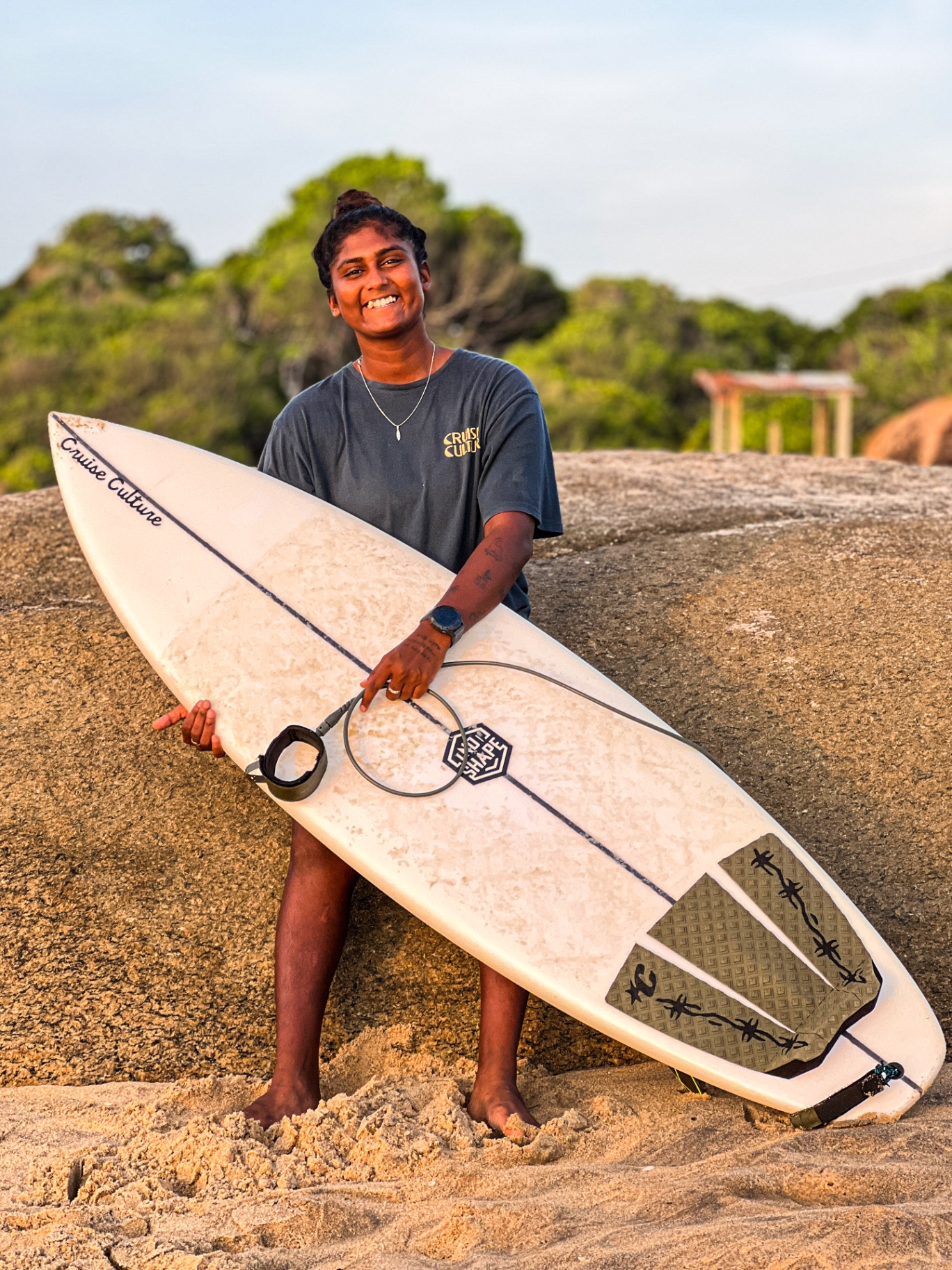
“People see the competition. The jersey. The scores. What they don’t see is everything before I even paddle out. They don’t see the stares in the lineup when you’re the only girl out. They don’t see having to prove you belong on every single wave. They don’t see changing behind a towel because there’s no proper space for women. They don’t see the pressure of knowing if I fall, people will say, “Girls can’t surf” — not, “She had a bad heat.” And they definitely don’t see the weight of carrying the hopes of every other Sri Lankan girl who wants to surf one day. It’s not just me vs the ocean. It’s me vs the ocean, the doubts, and the silence.” — Senu
It's not what we see, but what we don't. What we see is Senu surfing. A 23-year-old female surfer from Sri Lanka. Hitting lips, tucking in, gliding into expansive carves, showing us what the ocean means to her: “Peace that's loud, freedom that's real and presence that nothing else can give.”
What we don't see is everything she had to move through to get there, and everything she still fights against.
“Some days it feels like I'm fighting battles in the waves,” says Senu.
But what if the battle begins before she even reaches the water? The ocean is supposed to be our refuge. The place we go when the noise becomes too loud. When life asks too much. When we need to remember what it feels like to move without explanation.
What happens, though, when the place you go to escape the world is also a place where the world reminds you that you do not entirely belong?
“In the water, I compete against other surfers. That's normal. But outside the water, I also compete against: People expecting me to stay home instead of being in the ocean. The criticism of my skin becoming darker, or my hair being salty. The rejection from my family and them not giving me permission to surf.”
When Senu first started surfing, people in her village started talking about her. They would say, “She's a girl, she can't do that. She should focus on her studies.”
The battles she fights have little to do with the waves, and everything to do with ideas of what a woman should and shouldn't be. What she can and can't do.
“After I became a surf instructor and an ISA-qualified surf coach, I faced another big problem. One day, after I went surfing, a man there said some bad things to me. We had a small argument. Later, when I went back to the beach, he followed me and tried to talk to me again. At that time, he slapped me in the face. I just cried because I couldn't do anything. I was alone there. When I told my father, he said, ‘That's why I told you earlier not to do this.’’’
It was an uncomfortable introduction to surfing for her:
“I didn't know any girls who were surfing. In the beginning, I felt very alone. I didn't have a coach, and I didn't know how competitions worked. In the beginning, I didn't really think about competing. But there were no other girls there, so I thought I could show them what I could do. That's how I started competing.”
Perhaps that is where the contradiction begins. The ocean itself does not impose these conditions. The water does not care who you are. But the people around it can.
“I learned confidence isn't about winning. It's about paddling into a wave when 10 people are watching and thinking you can't. It's about trusting your body in big water. The ocean doesn't care if you're a girl. So I stopped caring too.”
For a long time, Senu thought she had to choose.
Be “strong” or be “feminine.”
Be an athlete or be a Sri Lankan girl.
Surfing showed her she could be all of it.
“I can be tough in the water and soft on land. I can wear a jersey and a saree. I'm not ‘a female surfer.’ I'm just me. And the ocean made space for me.”
Being a female surfer in Sri Lanka is a challenging landscape. It is not simply the decision of which break to surf today, but the courageous question: How strongly will I stand in a place I am told I do not belong?
In our lineups, gender disparity can feel like a normality. Are we still challenging history? Absolutely.
The lineup is not always a safe place. We are paddled around. Dropped in on. Looked at differently. Perceived as less capable. And then there is the inner realm we carry beyond the water — into the car parks, out of our wetsuits, and into the concrete labyrinth of everyday life.
For some women, the fight is not simply for equality in the lineup. It is for the belief that women belong in the water at all. Senu has watched that belief begin to change.
“When I started, and people heard ‘girl surfer' they would laugh. ‘That's dangerous.' ‘That's not for girls.' ‘Go home.' Now in Arugam Bay and Weligama, you see girls with boards. Girls are teaching. Girls are competing. People don't laugh as much when they see a girl paddle out. Parents are starting to say, ‘OK, try it' instead of ‘no.' I see moms bringing their daughters to watch heats. I see shop owners in Arugam Bay saying, ‘We have three girls surfing now.'’
The culture is opening up. Slowly. Perhaps change rarely arrives as a dramatic moment. Perhaps it arrives quietly: A girl carrying a board to the water. A mother allowing her daughter to paddle out. A shop owner notices there are three girls surfing now instead of one. A community slowly becoming accustomed to something it once believed did not belong.
“Did I change everything? No. But I think I helped open the door a little. People are starting to see that surfing isn't just a ‘boy thing.' It's a Sri Lankan thing. For everyone. And that's the biggest win for me.”
History often embeds itself most deeply in the things we cannot see.
Female surfers know this truth. This feeling. This ghost. The lingering stigma of a gender divide that has carried itself into our sacred place.
The water moves like memories unanchored, timelines that have let go. Yet we still paddle out carrying the residue of history. Perhaps this is what the ocean reveals so clearly: how easily timelines become preconceived ideas, and how those ideas can rupture an individual's freedom to experience something that someone else has always been allowed to experience.
And yet, what we want is not different.
We want to experience the ocean in the same way the male surfer does: in safety. In belonging. As a refuge from the feeling of us against the world. As a recalibration between ourselves and the ocean.
We are still refuting history's reluctance to remain past.
For many of us, surfing is an escape.
We leave the shore behind. We paddle beyond the noise of everyday life. For a few hours, the rules of the world seem to disappear.
But we must remember the rules don't disappear for everyone.
Senu is living with a courage that is slowly reshaping what we don't see.
Simply entering the water for her is an act of resistance.
For cultural shifts. For outdated beliefs. For the freedom of every young Sri Lankan girl who comes after her.
And perhaps that is why what Senu carries into the water matters beyond the competition.
“Beyond competing, I carry a lot that people don't see. I'm representing more than myself. When I paddle out, I'm surfing for me. For the feeling. For the wave. For myself. But the moment I put on the Sri Lanka jersey… I'm also surfing for every girl who was told "no.” Little girls watching me. Other Sri Lankan girls who want to try but are scared. If I quit, they might think, ‘See, girls can't do this.' So I have to keep going, even on bad days. There's the responsibility to prove we belong. To show sponsors that investing in women is worth it. To fight for equal waves, equal prize money, equal respect.
Unseen challenges? Funding. Safety traveling alone. Explaining to family why this is a ‘real job.' Dealing with comments online about how I look instead of how I surf. It's heavy sometimes.
But I'd rather carry it than let the door close behind me.
So I carry that hope with me. Not because I have to. But because I want the next girl to have it easier than I did. I surf for me. And I paddle for us.”
When Senu was asked what she hoped Sri Lankan girls would see when they watch her compete or paddle out, her response was bigger than any session.
“I hope she sees herself. I hope she doesn't see ‘a professional surfer.' I hope she sees ‘a girl from Sri Lanka, just like me.' I hope she thinks: ‘If she can do it, maybe I can too.' ‘If the ocean is safe for her, it can be safe for me.' ‘I don't have to choose between being Sri Lankan and being free.' I hope she sees that our place isn't just on the beach watching. Our place is in the water too. And most of all, I hope she sees that dreams are allowed here. Even the big, salty, scary ones.”